Plagiarsm Policy
Plagiarism Policy
Plagiarism Screening Policy
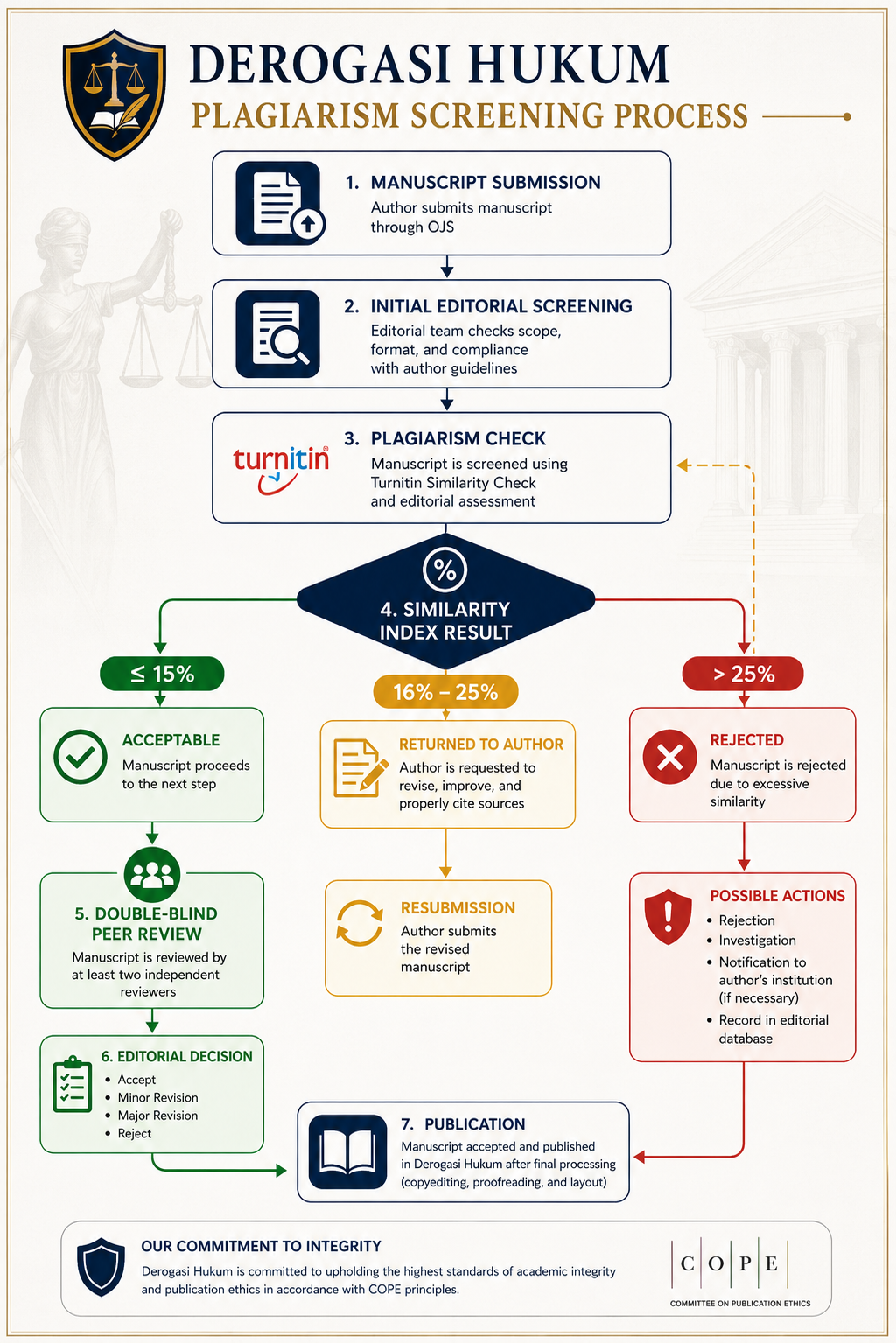
Plagiarism Screening
Derogasi Hukum is committed to maintaining the highest standards of academic integrity and publication ethics. All manuscripts submitted to the journal are subject to plagiarism screening before entering the peer review process.
The Editorial Board uses Turnitin Similarity Check together with editorial assessment to identify potential plagiarism, duplicate publication, self plagiarism, and other forms of academic misconduct.
Similarity Threshold
Derogasi Hukum applies the following similarity standards:
-
? 15% Similarity Index
The manuscript is eligible to proceed to the editorial review process. -
16%–25% Similarity Index
The manuscript will be returned to the author for revision, clarification, and resubmission. -
> 25% Similarity Index
The manuscript will be rejected due to excessive textual similarity.
The overall similarity percentage is not the sole basis for editorial decisions. Editors also evaluate the nature, location, source, and context of the similarities identified.
Definition of Plagiarism
Plagiarism is defined as the use of another person's ideas, words, data, figures, tables, images, or other intellectual property without proper acknowledgment and attribution.
Plagiarism includes, but is not limited to:
-
Direct copying without proper citation;
-
Inadequate paraphrasing;
-
Improper citation practices;
-
Self plagiarism or redundant publication;
-
Data plagiarism;
-
Figure or table plagiarism;
-
Duplicate submission and duplicate publication.
Editorial Policy
All submitted manuscripts must:
-
Be original works of the author(s);
-
Not have been published previously;
-
Not be under review by another journal simultaneously;
-
Properly acknowledge all sources used.
Authors are responsible for ensuring that quotations, paraphrased materials, figures, tables, images, and other borrowed content are appropriately cited.
Where copyrighted material is reproduced, authors must obtain written permission from the copyright holder prior to submission.
Classification of Plagiarism
1. Minor Plagiarism
Minor plagiarism refers to:
-
Small portions of copied text;
-
Inadequate citation;
-
Minor paraphrasing deficiencies;
-
Limited textual overlap that does not affect the originality or scientific contribution of the study.
Editorial Action
-
Authors will be requested to revise the manuscript.
-
Proper citation and attribution must be added before the manuscript proceeds to further editorial consideration.
2. Moderate Plagiarism
Moderate plagiarism refers to:
-
Significant textual overlap without proper attribution;
-
Extensive copying from previously published sources;
-
Substantial self plagiarism or redundant publication.
Editorial Action
-
Immediate rejection of the manuscript.
-
Authors may be required to provide clarification before future submissions are considered.
3. Severe Plagiarism
Severe plagiarism refers to:
-
Misappropriation of another author's original ideas, data, findings, or conclusions;
-
Duplicate publication of substantially identical work;
-
Fabrication, falsification, or manipulation of research data or content;
-
Any form of intentional academic misconduct.
Editorial Action
-
Immediate rejection of the manuscript.
-
Formal investigation by the Editorial Board.
-
Notification to the author's affiliated institution(s), when appropriate.
-
Additional sanctions may be imposed in accordance with the Committee on Publication Ethics (COPE) guidelines.
Self-Plagiarism
Authors must properly disclose and cite their previously published work.
Reusing substantial portions of one's own published material without appropriate citation constitutes self-plagiarism and may result in rejection of the manuscript.
Exceptions may apply to:
-
Standard methodology descriptions;
-
Conference papers that have been substantially expanded into journal articles;
-
Translated publications accompanied by proper disclosure and the necessary permissions.
In all cases, authors must clearly identify previous publications and obtain all necessary permissions.
Duplicate Submission
Simultaneous submission of the same or substantially similar manuscript to more than one journal constitutes unethical publishing behavior.
If duplicate submission is detected, the manuscript will be rejected, and appropriate actions may be taken in accordance with COPE and the journal's publication ethics policies.
Post-Publication Discovery
If plagiarism or other forms of academic misconduct are identified after publication, Derogasi Hukum will follow COPE procedures and may issue:
-
Corrections;
-
Expressions of Concern;
-
Retractions;
-
Article Removal (in exceptional circumstances).
Author Responsibility
All authors share collective responsibility for the originality, accuracy, and integrity of the submitted manuscript.
By submitting a manuscript to Derogasi Hukum, authors confirm that:
-
The manuscript is original.
-
Proper citations and acknowledgments have been provided.
-
The manuscript does not violate copyright or intellectual property laws.
-
The manuscript has not been submitted or published elsewhere.
-
The manuscript complies with the publication ethics and plagiarism policy of Derogasi Hukum.